Where do good startup ideas come from?
And what makes an idea great?

Chris Dixon put it perfectly when he said, “The pop culture view of startups is that they’re all about coming up with a great product idea. After the eureka moment, the outcome is preordained. This neglects the years of toil that entrepreneurs endure, and also the fact that the vast majority of startups change over time, often dramatically.” This was written twelve years ago and not much has changed.
An idea is at the same time the most and least important thing for a startup.
It’s the most important thing because for a long time the idea is all you have. You don’t have a product or customers yet. The idea drives belief. This could be huge. We have to keep going. The idea is how you get everyone excited to join in achieving your vision like early employees, pilot customers or investors1.
At the same time, the idea is also sort of irrelevant because it will inevitably change and evolve. Customers in a controlled study might say one thing, but ask a customer to use a product in exchange for money and you will get a much more real answer. No product survives impact with the customer. The idea will have to evolve2. You can’t expect to recruit employees or get investors onboard without a well thought through idea3. Most ideas at a high level are also fairly easy to copy. And for any good idea that seems obvious to you, there are definitely other people who also thinks is a good and obvious one. No idea is truly unique. A one in a million idea in the US means 340 other people have the same idea.4
Ideas are a bit like planning in terms of where the real value is found. The value of having a startup idea comes from the end to end thinking around things like how will this technically work, what legal or regulatory rules apply, what are the competitors and how do we differentiate, what’s our go to market strategy, etc. It sets an important direction for your nascent startup. Same goes for planning. The value is less so in having the literal plan than the process of sitting down and figuring out all the aspects of the plan. I always think of the Mike Tyson quote, “Everyone has a plan until they get punched in the face.” Plans get tossed out but the thinking that goes into making them is critical to quickly adapt after things inevitably don’t go as planned.
When people ask about my work at Gravity, the conversation inevitably turns to questions around the types of ideas we are investing in, the nature of good ideas and what exciting ideas we’ve seen recently.
To break this down there are really three separate questions:
Where do good ideas come from?
What makes an idea good?
How do you evaluate if an idea is actually good?
Where do good ideas come from?
The origins of an idea can come from a million different places. The founder narratives around these things are almost always revisionist history. AirBnb started as a breakfast cereal.5 Slack was originally an internal comms tool at a game company.6 Twitter was originally a podcasting app.7 A lot of great startups ideas are created in formulaic factories8 despite the stories that are told later. At Gravity we source ideas from a range of places: from first hand experiences of the partners, from potential founders we speak with, through partnerships with other venture funds, through ecosystem requests from the big layer 1 and layer 2 blockchains, and from collaboration with the corporate development arms of large financial institutions. We are constantly talking to all of these folks and asking a simple question: “What do you wish someone was building?” There is also a ton of time spent reading9 and playing around with new things that come out.
What makes a startup idea great?
The one commonality is that all good ideas start as an attempt to solve a problem. People will pay money to have their problems solved. Find a need, fill a need. Great ideas take this a step further and have a unique insight. These are usually a result of the unique experience of the Founder(s). Something very few people know or understand. Likely a slightly contrarian view. When Google launched there were 20 other search engines in market. Uber’s original pitch was basically to let a stranger get into your car. PayPal started as a way to beam money via the infrared functionality of a Palm Pilot. Great ideas are definitely a bit non-obvious at first glance.

How do you evaluate if an idea is actually good?
My recommendation is to start to write down every idea you have, no matter how good or bad. I keep a Notes file on my phone where the moment I’m thinking about something I write down what is is and my initial related thoughts. I don’t pass judgment on whether the idea is good or bad at this stage, I just capture the thought. You can build a process later to evaluate the ideas.
The way the best way to validate an idea is to talk to potential customers. An even better way to validate an idea is to put a product in front of them and see what they say. But this takes a lot more effort. There are a lot of other aspects of if an idea is investable (TAM, competitors, etc.) but these are orthogonal.
I’ll outline two paths I’ve used for evaluating ideas, one for personal projects and one we use at Gravity. These should serve as inspiration for how you might evaluate ideas yourself but at the end of the day you have to find a process that works for you. It needs to be lightweight enough that you can consistently run ideas through it, but comprehensive enough so that you are getting to some sort of answer on if the idea is worth pursuing. The balance between those things really depends on you and how much time you have to dedicate.
Path 1 - How I’ve evaluated side project ideas in the past
Important context here is that as I think about things I build on the side in my spare time, I’m weighting these on a few aspects: 1/ can I bootstrap this (does the idea work part-time without raising venture capital10), 2/ can I build it end to end myself with my technical abilities (as AI advances, very few things fail this test now) and 3/ when it is live, will it takeover my life to maintain (I’m only interested in side projects that are largely lifestyle businesses that don’t get in the way of my actual job).
That said, my method is pretty simple. First, I write everything down in a Notes file. Then every few weeks I transfer those ideas that still make sense11 to a giant spreadsheet. The spreadsheet has a very basic ranking system.
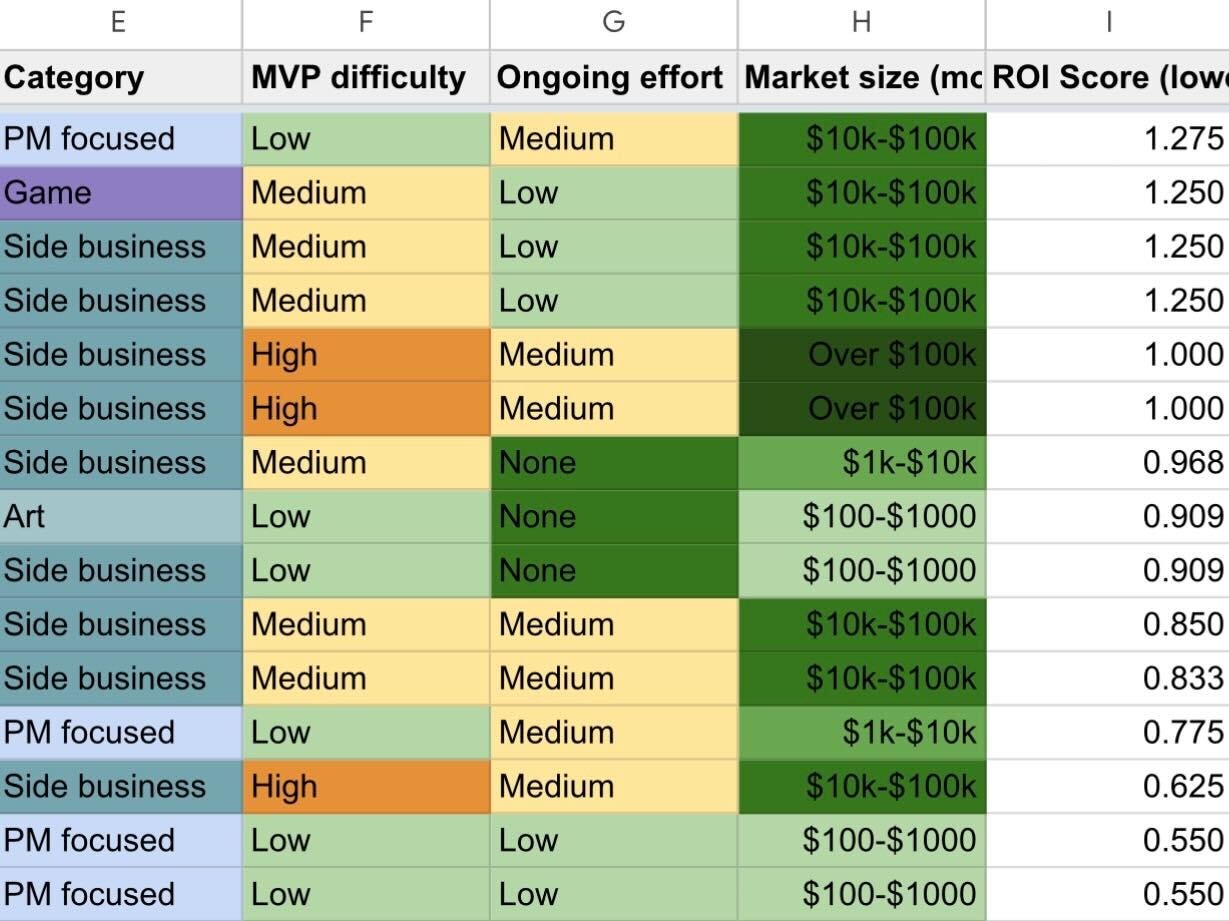
The ranges each have a value and the composite of those values forms the ROI score. I try not to spend more than 2-3 minutes categorizing something, that can always change later. I’m only looking for directional correctness to sift through the overall list and move the dumb things to the bottom and the interesting things to the top. I also try to group things into categories12 to be realistic about ideas that might be fun to build but probably aren’t a business.
When I have time, I’ll take a look at the top of the list and pick one idea to start working on. Sometimes this means trying to write out a few pages on what it could be and how it would work, followed by talking to some prospective users. Sometimes it means just jumping in and building because the act of building itself is fun to me. For the past few months I’ve been trying to post most of what I build on my personal site. I don’t really overthink it.
Path 2 - How we evaluate startup ideas at Gravity
Context here is that we are looking for ideas that map to a very specific strategy the fund at defy is running and this is my job. This path is much more thoughtful and rigorous than the first one.
Our process has a lot of stages and is difficult by design:
Sourcing ideas - mentioned above, we are constantly looking for ideas with unique insight
The big list of ideas - we write everything down
Researching ideas - some initial research to understand how it has been tried before (inevitable, all ideas have been tried) and form a rough point of view on if there is a different “why now” answer
Writing initial 2-3 page memos - I love driving clarity through writing. This is also how we ask another Partner at the fund to review and provide objective feedback. It provides structure to talk to more potential customers and domain experts to get specific feedback. Key question we ask ourselves is “would you still put your own money into this idea?”
Building a pitch deck - Start to figure out what the investor pitch could be and how to make it compelling. Key question here is “is this exciting enough for someone to quit their job to work on it with us?”
Writing a detailed investment memo - We go super deep. Talk to dozens of customers. Look at it from every angle. These memos are often 30-40 pages long. Key question for this stage is “for this to work, what has to become true?” If the answer is a very long list of things, the timing probably isn’t right.
Professionally polishing the pitch deck - take the pitch deck from stage 4, incorporate learnings from stage 5 and work with a designer to make it really professional.
Asking the defy investment committee for capital - as another forcing function for quality, we pitch everything to our investment committee same as any outside founders asking for capital would. Our rate of bringing things to this stage is 1 of every 29 ideas that gets the stage 3 memo ultimately gets investment. There is an opportunity cost to how many projects we invest in and launch so we want only the best ones to rise to the top.
Running a founder search, incorporating the new legal entity, helping the team build the initial product, etc. - mentioning for completeness but not totally relevant to this post.
We track what stage an idea is in but it isn’t exactly linear. Very often ideas go backwards and forwards in the process multiple time as they evolve. Timing is also highly variable. Some ideas we’ve ultimately invested in and launched have gone through the entire process in weeks. Others have taken a meandering path over the course of months. We think about it less in terms of moving projects through a funnel to hit quotas and more about what is the next immediate step we can make with each project to get to an answer. Getting projects to no (or at least no right now) is just as valuable as yes, let’s move it to the next stage.
So there you have it, my brain dump on ideas. When you start to work on a promising one, reach out and let me know. I love debating if early stage ideas are viable. If I think it’s great, I might invest.
Ok so technically early stage investors are probably making a bet on the team more than the idea itself but there has to be a team + idea component to get them excited about the possibilities.
If you don’t think your initial startup idea is going to evolve, you are not going to make it.
There are some wild AI examples where investors have put billions in without being told about what they intend to do. See Thinking Machines as an example. This is an extreme outlier.
A small rant about people insisting on NDAs purely around an idea. If you do this, you aren’t going to make it. If you can’t explain it crisply at a high level, your thoughts aren’t fully formed enough. If it doesn’t have some level of defensibility or strategic moat and NDAs are truly keeping it safe, it will just be copied endlessly. NDAs only make sense to me when you are going to share something very detailed about the idea. In our process to recruit founders, we only sign an NDA before we share the detailed investment memo which is often 30-40 pages of deep analysis on an idea.
I’m being a big glib. Technically the made cereal boxes to stay afloat, more detailed founding story here if you aren’t familiar.
Slack’s founding story. Fun fact, SLACK is actually an acronym for Searchable Log of All Communication and Knowledge.
Twitter’s founding story has a great book about it.
Or as we call them: venture studios. I have a theory that far more startups than folks realize were actually started in this way but as they took off the revisionist history founder narrative took over. What’s more exciting? To say “I was uniquely positioned to solve this problem, investors should give me money” or “yeah well I was paid to look through ideas and research them deeply and this idea is pretty good so please give me money.” Examples of companies that came out of venture studios: Uber, LinkedIn, Giphy, Bitly, Zynga, Medium, Foursquare.
This could be from serious industry sources or from silly lists. This past post has some good examples of sources that will likely be the origin of some of our 2026 investments.
This might seem ironic given I work at a venture fund, but it’s more that if you take someone’s money you have a lot of obligations and that’s not what I’m looking to do with a side project.
An example of an idea that must have made sense at the time but now I’m just like…what was I thinking here? Insurance for AGI wiping out humanity. Sort of genius because you wouldn’t have to ever pay out claims (there would be no users left!) but also pretty dumb because this doesn’t seem like it anyone is dumb enough to pay money for this. Also I’m no lawyer but I imagine this rife with legal concerns.
The other big themes that show up: racing and sneaker related ideas.